

Lavender can help deter clothes moths, but it is not a dependable treatment for an established infestation. A lavender bag does not deal with larvae already feeding inside clothing or carpet. If you have found fresh damage, webbing or live larvae, investigate the source rather than simply adding more fragrance.
For London homeowners, the useful question is not just whether moths dislike lavender. It is what a particular product can reasonably do, where its limits lie and whether prevention is still the task in front of you. This guide focuses on clothes and carpet moths, not outdoor moths or pests in food cupboards.

What does the evidence say about lavender?
English Heritage’s clothes-moth guidance includes dried lavender, sachets and gel products among alternatives to old mothball formulations, but explicitly warns that they are not effective on larvae. Its 2018 conservation advice also says lavender products need regular replacement.
That supports a limited role for lavender. It does not support promises that a handful of dried flowers will clear a room, protect every garment indefinitely or remove every life stage.
There is also uncertainty around household performance. University of California IPM guidance notes that little is known about the effectiveness of herbal oils used as repellents in stored clothing. A sensible reading is that an aromatic product may contribute to deterrence, while reliable protection still depends on how textiles and any existing infestation are managed.
Be cautious when an advert cites “research” without identifying the product, pest or test. A result for an oil in a controlled setting does not automatically establish how a dried sachet performs in your frequently opened wardrobe. Ask for the evidence behind the exact claim rather than assuming the plant’s name settles it.
Deterring, preventing, monitoring and treating are different jobs
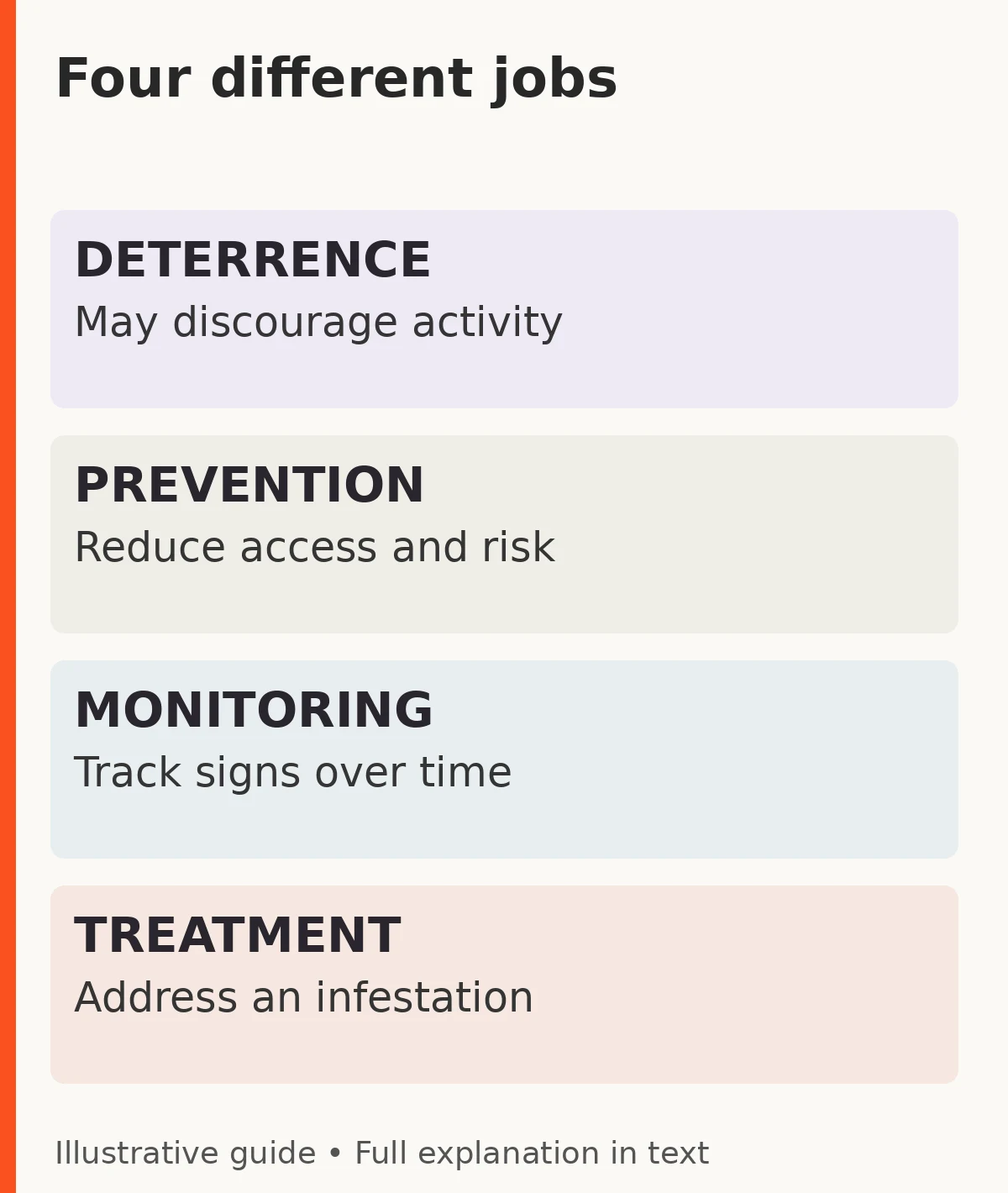
These terms are often used interchangeably on product pages, but they describe different outcomes:
- Deterrence: an attempt to discourage activity. A repellent claim does not necessarily mean insects are killed.
- Prevention: reducing opportunities for a problem to start, including limiting access to clean, pest-free textiles.
- Monitoring: gathering evidence of activity and changes over time.
- Treatment: addressing insects already present, with a method suited to the affected materials and locations.
A lavender bag is not a physical seal and it is not an inspection. Imagine an otherwise clean jumper placed in a box with a concealed larva already in its folds: adding a scent does not establish that the item is now clear. This is an illustrative example, not a reported customer case.
The stage of the insect matters too. Adult clothes moths do not eat textiles; the larvae cause the damage. Our carpet moth life-cycle guide explains why fewer visible adults do not necessarily mean hidden feeding has stopped.
Lavender sachets, oils and scented products: know the difference

Dried lavender bags
A dried-flower sachet is a simple aromatic product. If you choose to use one, treat it as an optional addition to textile care. Keep it contained, follow any placement instructions and make sure it cannot spill into garments. Do not let a sachet replace checking the contents of a neglected drawer.
There is no useful universal answer such as “two bags protect every wardrobe”. The size of the space, product format and stated directions differ. A replacement schedule printed on one packet should not be transferred to a different product.
Lavender essential oil
An oil bottle is not interchangeable with dried flowers. Avoid inventing a dose, pouring oil onto clothes or saturating carpet in an attempt to reach hidden larvae. Check the product’s intended use and the textile’s care requirements before introducing it around valuable materials.
“Natural” does not establish suitability for every household or surface. Follow the actual product’s precautions, including any restrictions involving children or animals. If the instructions do not cover the use you have in mind, ask the manufacturer rather than adapting an online recipe.
Lavender-scented moth products
A product can smell of lavender while containing other ingredients responsible for its claimed action. Read the active ingredients, target pest, intended setting and directions. Do not assume the fragrance tells you whether it is a repellent, an insecticide or simply a wardrobe freshener.
When comparing packets, compare the stated purpose as well as the price. A fragrance product and a product labelled for a specific moth-control use may be answering different needs. Neither should be used outside its instructions.
Four questions to ask before trusting a moth-repellent claim
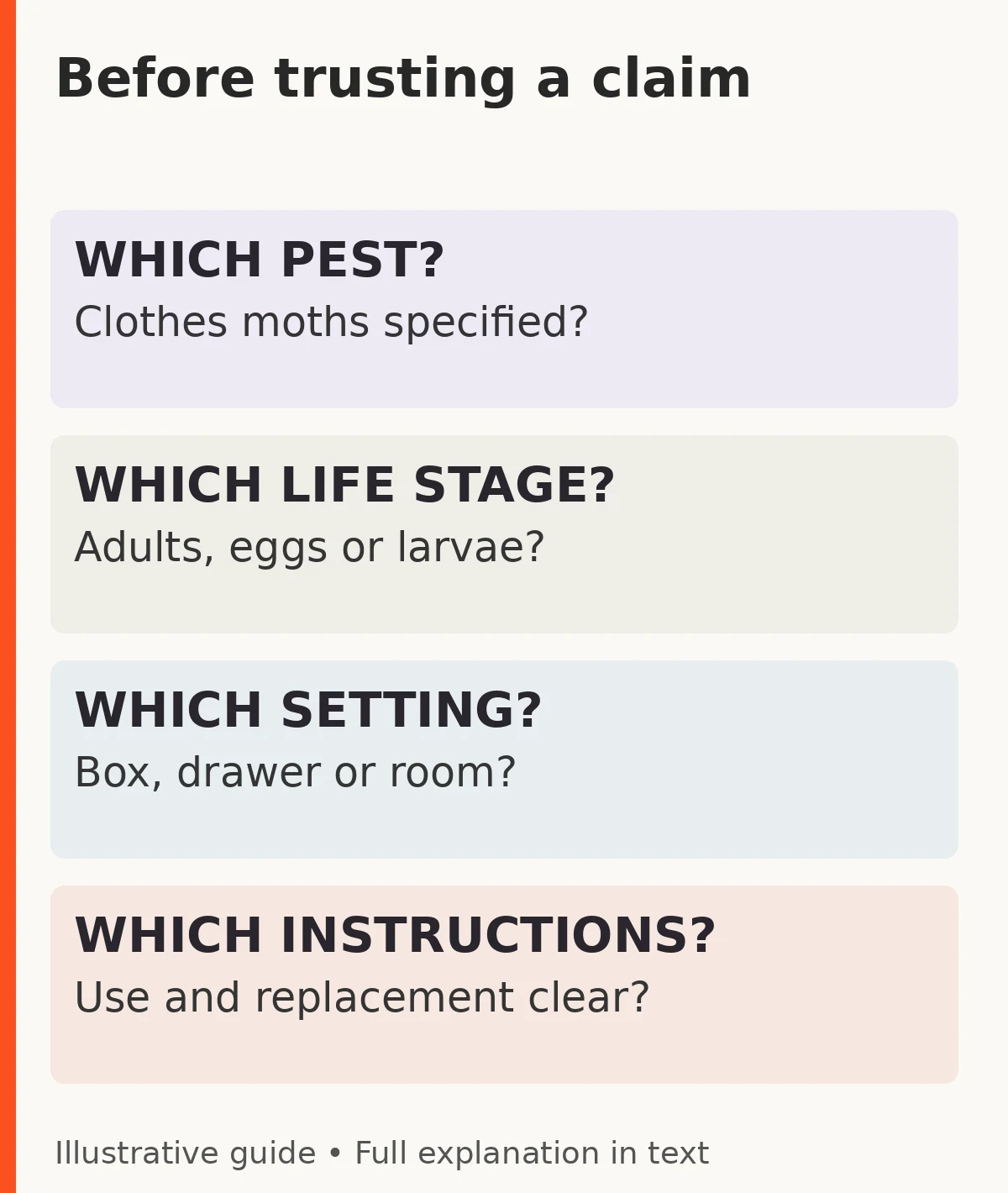
- Which pest is specified? Look for clothes moths, not just a broad promise about “bugs”. Pantry moths require a food-source investigation, and carpet beetles are a different textile pest.
- Which life stage and outcome are covered? “Repels adults” is a narrower claim than controlling eggs or feeding larvae. Check what “protection” actually means in the supporting information.
- Which setting was considered? A small closed container is not the same environment as an open wardrobe, walk-in dressing room or carpeted bedroom. Do not stretch a product’s stated coverage.
- Are use and replacement instructions clear? You should be able to identify where it belongs, how it is used and when it needs replacing. If those details are missing, ask before relying on it.
Customer reviews describing a pleasant smell answer a fragrance question. Even a review reporting no moths cannot tell you whether that home had an infestation initially, what else the owner did or whether hidden larvae were checked. Use reviews for practical details, but do not treat them as a controlled efficacy test.
What about cedar, and what should you rely on instead?
Cedar has similar limitations as a stand-alone answer. Utah State University Extension explains that cedar-lined cupboards and chests have limited value because repellent concentrations are difficult to maintain over time. Swapping lavender for cedar does not resolve the underlying question of whether insects are already present.
Prioritise clean, pest-free textiles and sound storage. For the full practical routine, use our clothes-storage guide. Buying another scented accessory should come after deciding whether you need prevention or investigation.
Keep a simple record if you are concerned: the date, room, garment and what was actually found. Photographs of a suspected insect or webbing are more useful than “the wardrobe smells strongly of lavender”. Our home moth-inspection guide sets out where to look without relying on fragrance as an indicator.
The National Pesticide Information Center recommends identifying the pest and finding affected materials before choosing control measures. That matters because an unrelated moth at a window or an old hole does not establish an active textile infestation.
Suitable pheromone traps can add evidence, but captures must be interpreted alongside inspection. Our moth monitoring service supports that process. An empty trap is not a certificate that every concealed larva has gone, and it is not proof that a lavender product worked.
When fresh damage means it is time for treatment
If you find live larvae, webbing or continuing damage, separate suspect movable textiles before carrying them through the home. Arrange suitable cleaning or specialist advice, taking account of care labels. Do not keep experimenting with increasingly strong scents while valuable materials remain at risk.
Repeated or widespread activity calls for an assessment of the source and extent. Professional moth treatment can then be matched to the property. Controlled moth heat treatment is one option for suitable areas and contents; a targeted programme may be appropriate in other circumstances.
Moth Treatment Pros is a specialist textile-pest company, part of the ThermoPest group. Check our current treatment pricing and London service coverage, or request an assessment with photographs and a short account of what you have found.
Frequently asked questions
Does lavender kill moth eggs?
Do not rely on a lavender sachet to kill eggs. A repellent claim is not evidence of egg control. Suspect textiles need an appropriate cleaning or treatment method selected for the material.
How many lavender bags should I put in a wardrobe?
There is no universal number that guarantees protection. Follow the instructions for the exact product and space. Adding more bags does not turn a deterrent into treatment for an established infestation.
How often should lavender moth sachets be replaced?
Use the manufacturer’s replacement guidance. English Heritage advises regular replacement, but does not give one interval that applies to every lavender product. A noticeable scent alone cannot confirm moth protection.
Can I use a lavender-scented moth product instead of dried lavender?
Check its label. Lavender fragrance does not tell you what the active ingredients are or whether the product repels or kills moths. Follow its stated uses and precautions rather than treating all lavender-scented products as equivalent.
Is cedar better than lavender for clothes moths?
Neither should be your sole defence against an active infestation. Cedar’s effectiveness also depends on maintaining suitable concentrations, which can be difficult. Choose cleaning, sound storage and appropriate treatment according to the evidence, rather than comparing scents alone.