

The carpet moth life cycle has four stages: egg, larva, pupa and adult. Larvae cause the textile damage; the small moths you see are the reproductive stage. Development usually takes months, but temperature, food and species can change the timing substantially. There is no single number of days after which an untreated infestation must disappear.
If moths keep appearing after you have vacuumed or removed a damaged item, understanding those stages helps explain why. This guide focuses on textile moths in UK homes, not outdoor moths or the moths found in food cupboards.
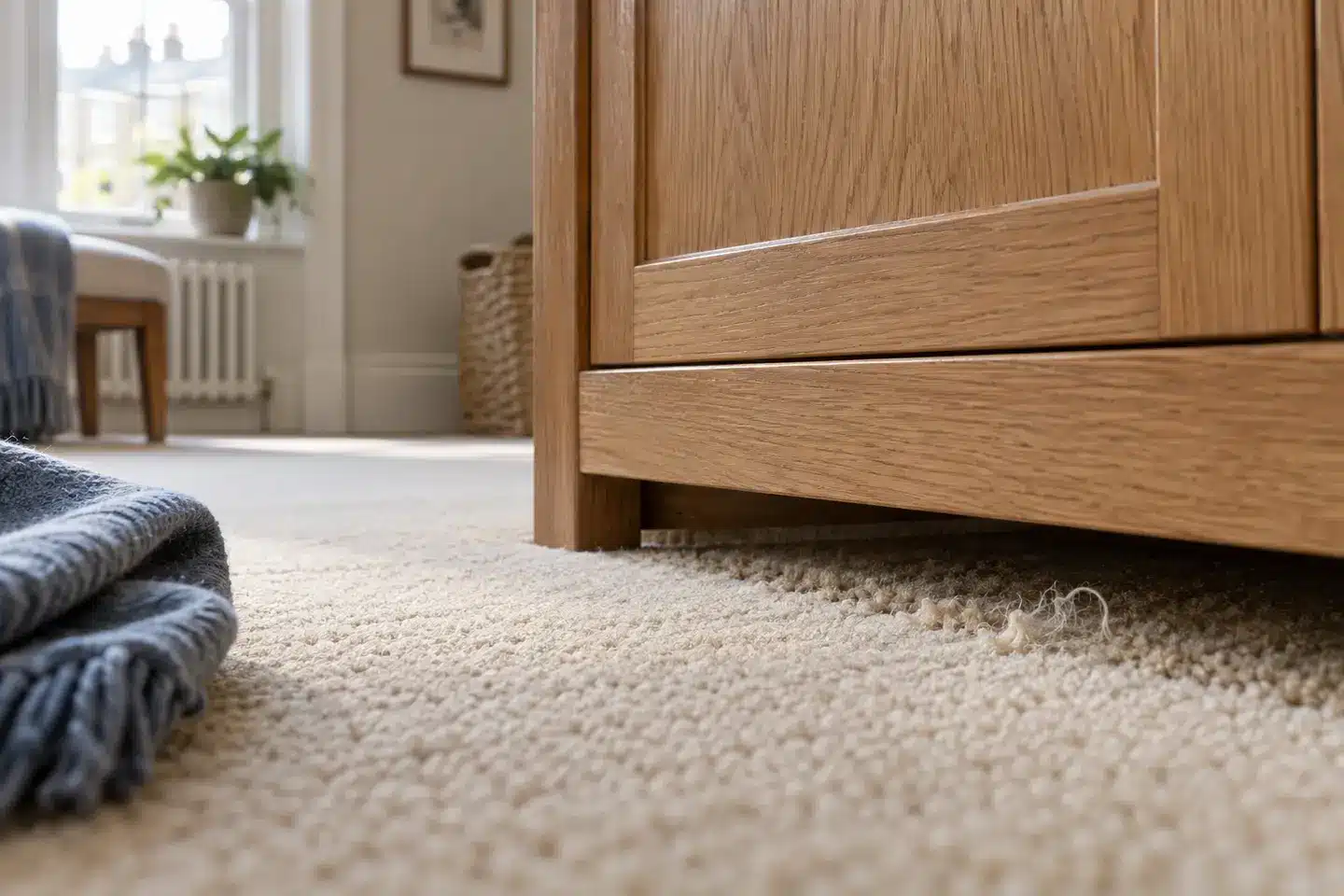
Are carpet moths and clothes moths different?
“Carpet moth” describes where the damage is happening, but it is not a reliable species identification. Clothes moths can develop in suitable carpets, rugs and furnishings as well as garments. The webbing clothes moth, Tineola bisselliella, and case-bearing clothes moth, Tinea pellionella, are two important textile pests.
Both pass through the same four stages, but their habits and development times are not identical. That is why a generic moth timeline should not be used to date an infestation or decide that a property is clear.
Webbing in cereal, flour or pet food needs a separate food-pest investigation. Hairy larvae or bristly cast skins may instead indicate carpet beetles. Identify the insect before applying a moth-specific explanation.
The four stages of the carpet moth life cycle
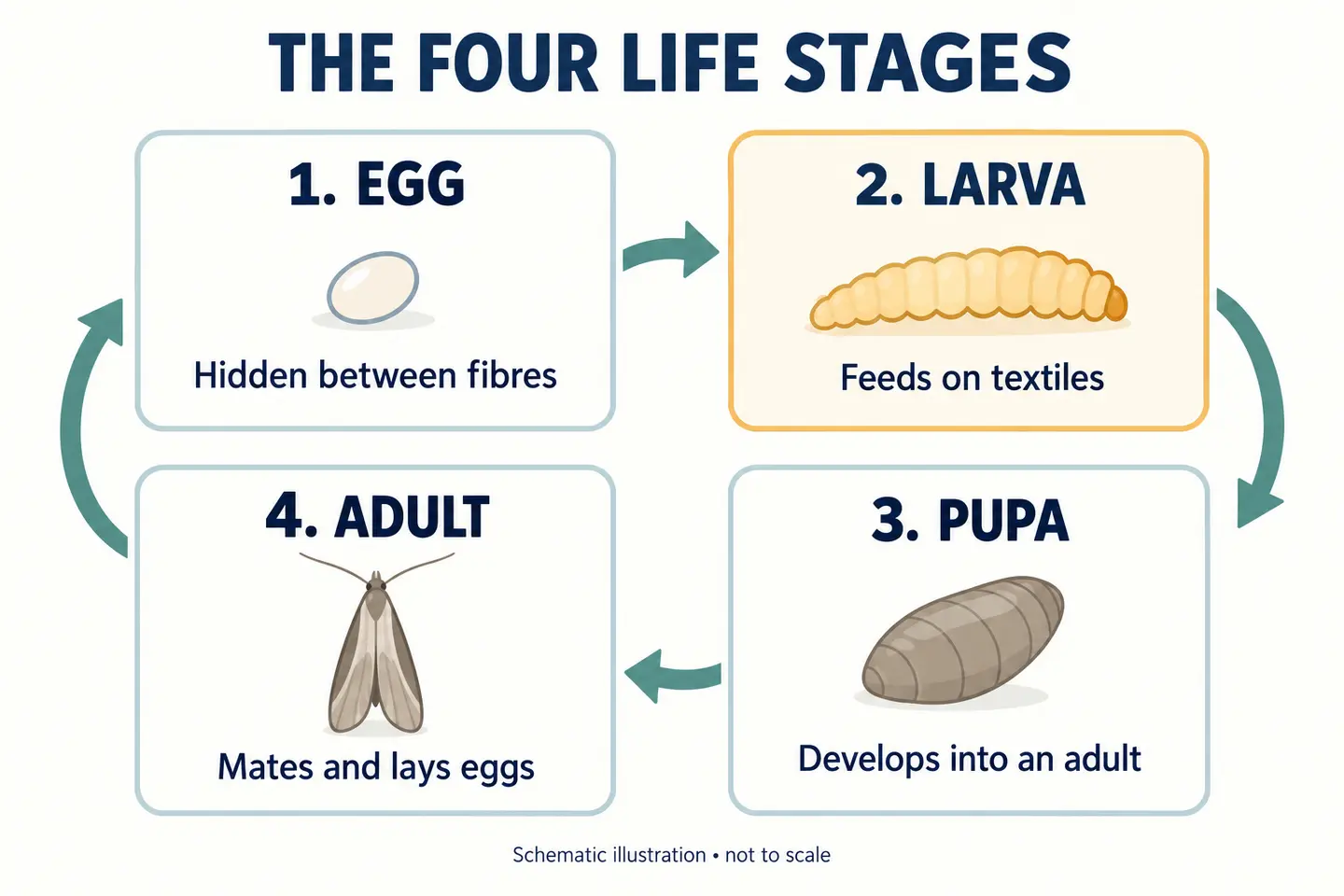
1. Eggs: the concealed beginning
Female clothes moths lay eggs near material that can support their larvae. Eggs can be attached amongst textile fibres or hidden in folds and crevices, making them difficult to confirm with the naked eye.
The University of California’s clothes-moth guidance gives an egg-hatching range of about 4–10 days in warm weather. Treat that as a biological reference, not a countdown that applies to every London room.
The practical implication is simple: removing an adult does not tell you whether it has already laid eggs. Equally, a white speck in carpet is not enough to identify an egg. Avoid deciding the extent of a problem from either observation alone.
2. Larvae: the stage that damages textiles
Once eggs hatch, the larvae feed and grow. Wool, fur and feathers provide suitable animal-based material. Feeding can remove carpet pile or create holes in vulnerable textiles, often in sheltered areas that receive little disturbance.
Webbing clothes-moth larvae produce silk associated with their feeding areas. Case-bearing larvae carry a protective silk case that they enlarge as they grow. Those are different structures: not every moth larva carries a portable case.
The English Heritage webbing clothes-moth factsheet describes larval growth taking nearly a year in unheated buildings, with faster development possible in heated conditions. This hidden feeding period explains why the lifespan of an adult moth is a poor measure of how long a problem can persist.
3. Pupae: a quiet stage, not proof of clearance
At pupation, the insect changes from a larva into an adult. Webbing clothes moths pupate in a silken cocoon, while mature case-bearing larvae can move away from their feeding material before pupating.
University of California guidance gives about 8–10 days for pupation in summer and 3–4 weeks in winter. These are examples of how conditions change timing, not a promised waiting period for a treated property.
A case found on a nearby surface therefore does not necessarily mark the original feeding source. The case-bearing clothes-moth factsheet hosted by Collections Trust explains this movement and the empty cases left behind after adults emerge.
It helps to distinguish the insect from its covering. An old silk case can remain long after it was occupied; it is not, by itself, evidence that a live pupa remains inside.
4. Adults: reproduction, not carpet feeding
Adults emerge, mate and lay the next generation of eggs. The visible moth is not the stage chewing through wool carpet. Its appearance can draw attention to feeding that happened earlier, out of sight.
Adult life is relatively short compared with the potentially lengthy larval stage. University of California guidance describes females laying eggs over roughly two to three weeks, with males surviving longer. Waiting for individual adults to die does not remove the other stages already present.
How long does the complete life cycle take?
Think in terms of a variable cycle, not one fixed lifespan. English Heritage’s overview describes a generation commonly taking about a year, with up to three generations in warm conditions. Published timings describe different environments and should not be treated as competing guarantees.
For a homeowner, three questions matter more than choosing a single figure:
- Which species is present? A timeline for one textile moth is not automatically a timeline for another.
- What conditions exist around the insects? The temperature behind furniture or in a stored textile can differ from the room’s most exposed area.
- Is suitable food still available? A surviving source can sustain larvae even after the most obvious damaged garment has been removed.
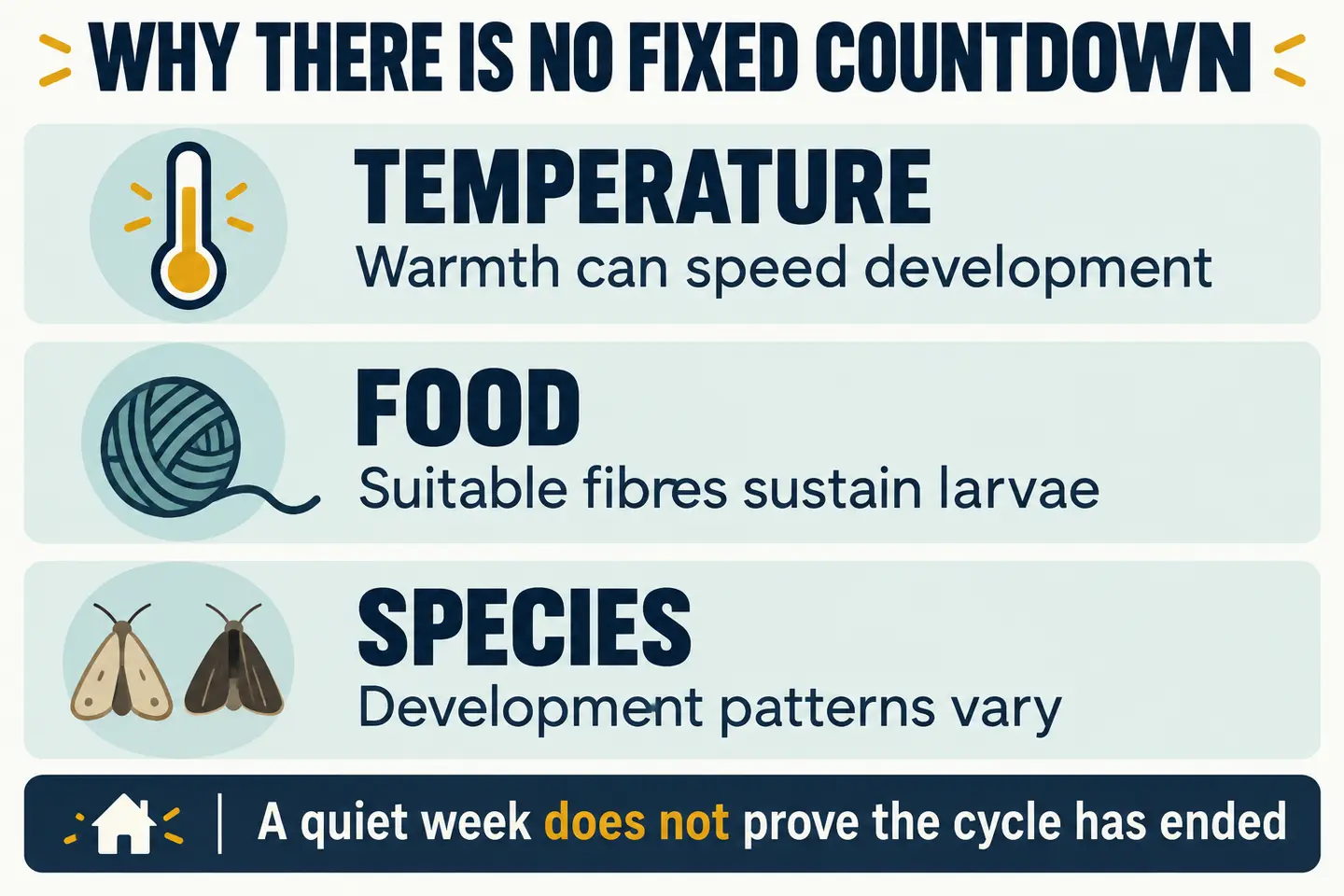
A life-cycle illustration also shows stages one after another, but a real infestation need not be synchronised. Eggs, small larvae, mature larvae and pupae may be present at the same time. A quiet interval can therefore be followed by another adult emergence without the whole population having started again that week.
Why do moths keep appearing after cleaning?
Cleaning is useful, but repeated sightings deserve interpretation rather than guesswork. Consider these possibilities with any other evidence you have:
A concealed source remains
Cleaning the accessible carpet does not establish what is beneath fitted furniture or inside an affected textile. For example, a cleaned wardrobe and an untreated wool rug represent two different areas to account for. That is an illustrative scenario, not evidence that every recurring infestation has multiple sources.
Use our room-by-room moth inspection guide if you need the practical search steps. Keep a note of places you could not safely reach rather than assuming they were checked.
You removed one stage but not the whole source
Seeing fewer adults can be encouraging, but it does not directly measure eggs, larvae or pupae. It is more useful to ask what evidence has changed: are you seeing new damage, finding live larvae, or simply noticing moths at a different time?
There has been another introduction
Newly brought-in textiles are also worth considering. Record when a rug, stored box or second-hand furnishing arrived, but do not assign blame from timing alone. A recurrence can reflect an old source, a new introduction or an incorrect original identification; it cannot reliably distinguish between them on its own.
What does the life cycle mean for treatment?
A treatment plan needs to account for both the insects and the material supporting them. Ask which areas and contents are included, what preparation is required, what cannot be treated by the chosen method, and how follow-up findings will be assessed.
Our professional moth treatment options include different approaches for different circumstances. Where suitable, controlled moth heat treatment is an option for affected areas and appropriate contents. Suitability and access matter; household heating is not a substitute for a professionally controlled process.
A planned spray programme may involve repeat visits. Do not calculate the interval yourself from an egg-hatching figure: the product, application, survey findings and instructions from the treating company all matter. Do not add extra insecticide or wash treated surfaces without checking the aftercare guidance.
After any treatment, a moth sighting is information to report, not automatic proof of either success or failure. Request an explanation tied to the method actually used. Live larvae, fresh feeding evidence or activity in an additional room are useful details to pass on promptly.
Keep an evidence record instead of counting down days
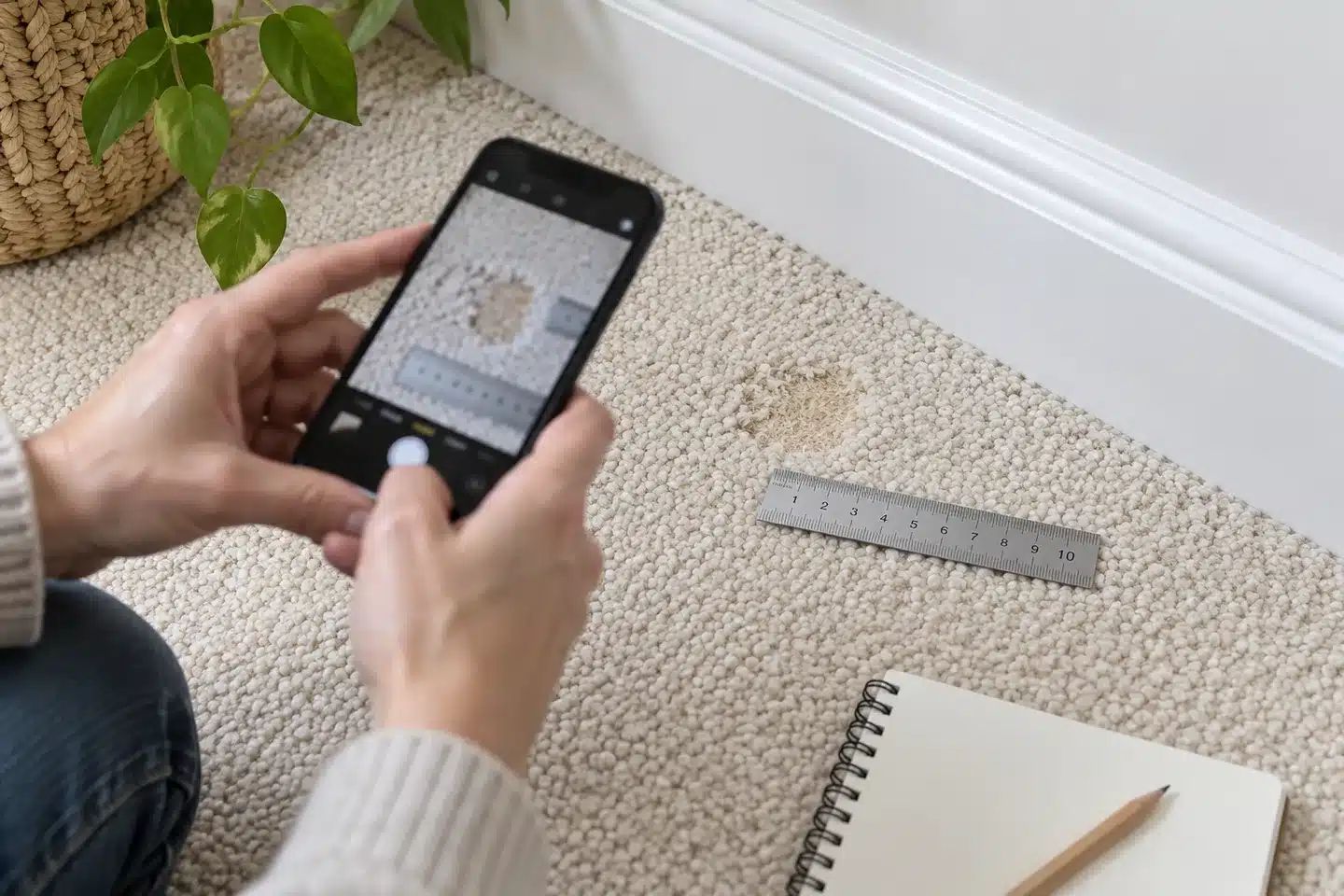
A short, consistent record makes follow-up more useful. You do not need to turn your home into a laboratory; you need to be able to compare like with like.
- Record a baseline. Photograph the affected patch with a ruler and note the room, exact position and date. Existing damage will not repair itself after control.
- Describe the evidence. Separate adult sightings, live larvae, empty cases and changes in the textile. “Two adults beside the bedroom wardrobe” is more useful than “moths everywhere”.
- Record actions and changes. Note cleaning, moved furniture, new textiles and treatment visits so a change in activity has context.
- Compare the same places. Revisit accessible marked areas and photographs. Avoid repeatedly moving suspect items between rooms.
- Agree the next step. If a company has treated the property, follow its review schedule and report concerning findings sooner.
Moth monitoring can support this record. Suitable pheromone traps indicate adult male activity, but cannot certify that all hidden life stages are absent. Record trap location and replacement dates, and interpret catches alongside physical evidence.
Frequently asked questions
How long do carpet moth eggs take to hatch?
Clothes-moth eggs can hatch in around 4–10 days in warm conditions. This is a reference range, not a fixed deadline for every species or home; colder conditions can slow development.
How long do carpet moth larvae live?
The larval stage commonly lasts months and can be much longer under unfavourable conditions. The species, temperature and available food affect development, so a short period without adult sightings does not establish that larvae have gone.
Do adult carpet moths eat carpet?
No. Textile damage is caused by the larvae, not the adult clothes moths. Removing flying adults alone does not deal with the feeding stages already concealed in carpet or other textiles.
Can moths complete their life cycle in an empty room?
Yes, if suitable food remains. An empty room can still contain wool carpet, animal-fibre furnishings or accumulated hair and lint. Removing people or furniture is not, by itself, a treatment.
Does an empty moth case mean the infestation is still active?
Not necessarily. Empty cases can remain after an adult has emerged and after successful control. Record and remove accessible old debris, then look for fresh evidence; a live larva is more informative than an old case.
How long after treatment should all moths disappear?
There is no universal deadline. Ask the treating company what to expect from the method used, when follow-up checks are due and which findings require a call. Report live larvae or new damage rather than waiting for an assumed life-cycle end date.
When to get specialist help
If you are finding live larvae, further damage or repeated activity without a clear source, arrange an assessment. Share your photographs and record, including any previous treatment and inaccessible areas. There is no need to wait for an assumed life cycle to finish before seeking advice.
Moth Treatment Pros is a trading name of ThermoPest Bed Bug Treatment London Ltd and specialises in textile-pest work. See our London service coverage and current treatment pricing, or request an assessment for advice based on your property.